 The Karolinum Press has just launched my book on political economics. The book aims at undergrads and graduate students who want to study politics from an economic point of view. I welcome any comments to the book that can be purchased in Karolinum Press Bookshop, Celetna Str., Prague, or via online shop.
úterý 31. ledna 2006
Out, at last
The Karolinum Press has just launched my book on political economics. The book aims at undergrads and graduate students who want to study politics from an economic point of view. I welcome any comments to the book that can be purchased in Karolinum Press Bookshop, Celetna Str., Prague, or via online shop.Theoretical Cuisine
 This picture shows theoretical cuisine, in other words, ideal food without real substance. This is everyday meal of any theoretician. Delicious, if you get used to it.
pondělí 16. ledna 2006
A Liberal Sexual Society
I declare myself a cultural conservative. That is, I think that the most valuable artwork and writings deal with human responsibility to supraindividual values. (Two recent examples are "Santini's Tongue" by Czech Milos Urban and 2001 Pullitzer Prize "The " by Michael Chabbon.) The culture of masters as written for us, plebs, should be both adventurous, thrilling, exciting, and deeply rooted in certain values. "Deconstruction" is, in my eyes, nothing but a synonymum for work "under hopeless construction". Echoing only individual needs, for example sexual ones, reveals sooner or later pretty dull and empty.
On the other hand, I would never promote certain culture by any general policy. Speaking on sexuality in particular, I find restrictions useless and often counter-productive. No, now I don't speak only about abuses by homosexual priests... I think of my childhood, late 80s, when sexuality was behind a very thick cover. In spite of restrictions, there was a high dispersion of sexually transmitted diseases at that time. The age of the first intercourse was pretty low. And, most importantly, one could find the symbol of vagina on each and every corner.
After more than a decade of liberation, we have, as far as I know, a lower rate of sexually transmitted diseases. The age when youngsters begin to live sexually has not dropped, rather the opposite. And the vagina symbol moved into the theatre (recall Vagina Monologues) where it found the audience of frustrated female singles.
A liberal sexual society proves to be sexually more healthy. Cultural conservatives should also understand the price: people pay much more for sexually-related entertainment than on high culture.
On the other hand, I would never promote certain culture by any general policy. Speaking on sexuality in particular, I find restrictions useless and often counter-productive. No, now I don't speak only about abuses by homosexual priests... I think of my childhood, late 80s, when sexuality was behind a very thick cover. In spite of restrictions, there was a high dispersion of sexually transmitted diseases at that time. The age of the first intercourse was pretty low. And, most importantly, one could find the symbol of vagina on each and every corner.
After more than a decade of liberation, we have, as far as I know, a lower rate of sexually transmitted diseases. The age when youngsters begin to live sexually has not dropped, rather the opposite. And the vagina symbol moved into the theatre (recall Vagina Monologues) where it found the audience of frustrated female singles.
A liberal sexual society proves to be sexually more healthy. Cultural conservatives should also understand the price: people pay much more for sexually-related entertainment than on high culture.
čtvrtek 5. ledna 2006
2006: The Judgment Year
On New Year’s Eve
To sort out who may win and who not, it is necessary not to watch media and policy groups only. The reason is that we have clearly right-wing leaning media; also right-wing think tanks dominate left-wing ones (by five to zero). The influential young people are simply on the right.
But is it sufficient to predict that right-wingers win? No. Consider my generation of late 20s, early 30s. We are descendants of extremely egalitarian society. According to Michael Förster’s 2005 OECD study, Czech society has the lowest share of population in the least income deciles. Only 4% of people have an income below half of average (sic!). Among the new EU member states, the 20% of poorest have the highest share of total income (see World Development Indicators 2005).
This explains why Czech young elites dislike egalitarian policy. They cannot demand it, because they grew in extremely egalitarian conditions, and attribute all personal achievements to individual effort.
The generation forming public opinion in media must inevitably be against left-wingers; but that’s not enough to secure a win. Older generations have a different idea on how the state should equalize, based on their experiences, or, perhaps, misconceptions from the past. Unfortunately, these driving motives are difficult or impossible to un-root. Hence, I see the future of the Czech right rather bleak, even if I personally wish the opposite.
pondělí 2. ledna 2006
The Very Merry Christmas
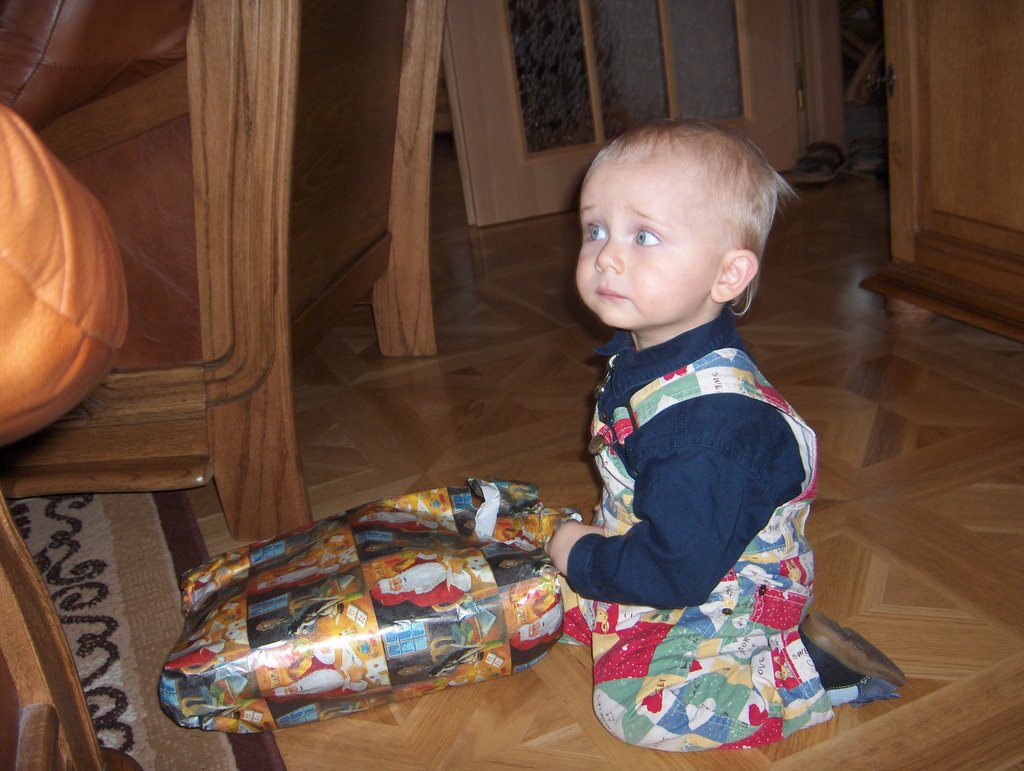
Jachymek's visit was great, as usually, especially his joy from unpacking gifts where he expected only cars was so sweet. A funny and lovely gentleman. The complete photopage is here.
Xmas Party
Eva von Kreuzberg made a splendid Xmas party, where I was a gloegg-wizard, Tomas Vyhnanek a chief entertainer (see below), and Her Majesty Eva was an excellent hostess.

úterý 13. prosince 2005
Is Economics a science?
S&T Eurobarometer reports the average view of the Europeans (EU-25) on what is regarded as scientific. Medicine is leading on a five-point scale (4.6), Physics closely behind (4.4).
What about Economics? We got 3.2. Comparing to Horoscopes (1.9), that is quite good. But look at Astrology and Homeopathy: both of them got 3.1.
We have two interpretations of the data. The first one is that we don’t work hard; we have to present ourselves such that we get at least to the level of Psychology (3.6). The second one is plain: don’t believe voice of the European street. It is the same vox populi that, for example, considers
čtvrtek 8. prosince 2005
Austrian School Conference (Post Scriptum)
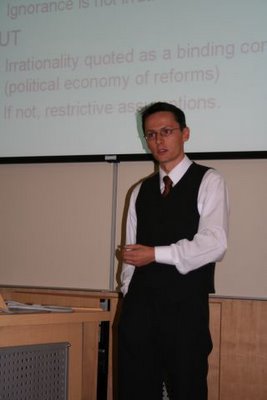
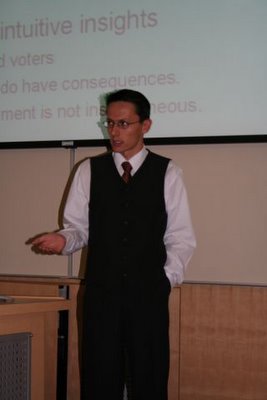
From the Wirth Institute, I've today received nice shots taken during my address at the conference in Edmonton. Economi(cs/sts) can be sexy, can't they? :)


středa 7. prosince 2005
Laffer what?
I like liberal economics. Equally, I don't like bad economics. Unfortunately, often liberal economics overlaps with bad economics. A recent example is Petr Mach's leading article "Flat Corporate Tax and Laffer Curve" in CEP newsletter 11/2005. Mach estimates the impact of corporate tax rate on revenues from this tax, and identifies the top of Laffer's curve at about 20.75%. This sounds cool, but let's take a clooser look...
The estimate is based on OLS conducted over 5(!) observations over the last five years. Not many degrees of freedom, I suppose. Over the period, we observe steady decline in tax rate, and dramatic increase in taxable profits. The Mach's estimate assumes that the increase in profits is solely due to the change in tax rate, which is doubtful. In period of boom, with large foreign investments (excluding those exempt from taxation), changes in profits should be attributed to other causes than the tax rate. Three most evident causes may be general boom, competition for foreign investors, and tax competition.
Therefore, the estimates of Laffer curve and of predictions of revenues at 15% rate (as proposed by the Civic Democratic Party), are unfounded. The party should be cautious to propose a generous social system accompanied by a drop of corporate tax rate, since the only result can be growing deficits. So, I am in favour of lower corporate taxes, but not for wrong reasons.
The estimate is based on OLS conducted over 5(!) observations over the last five years. Not many degrees of freedom, I suppose. Over the period, we observe steady decline in tax rate, and dramatic increase in taxable profits. The Mach's estimate assumes that the increase in profits is solely due to the change in tax rate, which is doubtful. In period of boom, with large foreign investments (excluding those exempt from taxation), changes in profits should be attributed to other causes than the tax rate. Three most evident causes may be general boom, competition for foreign investors, and tax competition.
Therefore, the estimates of Laffer curve and of predictions of revenues at 15% rate (as proposed by the Civic Democratic Party), are unfounded. The party should be cautious to propose a generous social system accompanied by a drop of corporate tax rate, since the only result can be growing deficits. So, I am in favour of lower corporate taxes, but not for wrong reasons.
Pokrok navzdory (article for Dec 05 issue of "Sociál")
S Fakultou sociálních věd, konkrétně s IES a IPS, mám zkušenost trvající právě deset let. Za tu dobu jsem zaznamenal obrovský vývoj. Stačilo ale, abych nedávno detailně nahlédl do střev fakulty, a zjistil jsem, že velká část pokroku se odehrála spíše navzdory fakultě než jejím přičiněním.
Mluvím-li o fakultě jako celku, nikoli o jednotlivých institutech, nemohu se ubránit pozorování, že máme co do činění s koalicí byrokratů a neproduktivních výzkumníků. Z byrokracie je největší hydrou ekonomické oddělení. Tento tvor se krmí z grantů pomocí tzv. „institucionálního zabezpečení“ (jen v doktorském grantu, který jsem pomohl zajišťovat, čítala letošní položka 200 tisíc). Za odměnu ekonomické oddělení vycení zuby pokaždé, když mu předložíte cokoliv jiného než upravené finální dokumenty. Nezbývá než se starat o administrativu vlastními silami, nemluvě o tom, že v případě zahraničních grantů není tvor ochoten vůbec komunikovat v angličtině.
Fakulta stojí na politické paritě institutů. Díky tomu stojí na stejné úrovni renomovaní a citovaní odborníci s lidmi, kteří odčerpávají zdroje ze skutečného výzkumu na svoji Potěmkinovskou (v Americe se říká „Mickey Mouse“) vědu. Není pak divu, že ve Vědecké radě FSV se klíčovou otázkou výzkumu nedávno stala barva obálky fakultního sborníku. Lidé, kteří nesledují recenzované žurnály a nepřispívají do nich, kteří neakceptují, že jediným vědeckým jazykem je angličtina, rozhodují o ostatních pouze na základě proporčního zastoupení.
Když se diskutovaly finance ve Výzkumném záměru, jeden prominentní žurnalista-proděkan označil odměňování na základě výstupu za postup analogický najímání vrahů. Anebo vezměme jinou prominentní žurnalistku-proděkanku, doc. Köpplovu. Ta otevřeně lhala ohledně akreditace doktorského programu ekonomie, než ji usvědčilo detektivní hledání kopií akreditace na rektorátu UK. Přinejmenším o rok zpozdila převod doktorského studia do anglického jazyka, čímž jej uzavřela pro zahraniční zájemce.
Na FSV se nachází celá řada výkonných a talentovaných výzkumníků, učitelů a studentů. K jejich růstu je ale nutná odborná, morální a finanční podpora. Fakulta by se mohla starat alespoň o finanční složku. Před současným děkanem zde proto vidím rozvojový úkol: provést reformu byrokracie, narušit neproduktivní status quo a prosazovat diferenciaci při odměňování. Byrokracie by měla být výkonná a dobře zaplacená. Ve Výzkumném záměru by mělo být financování zcela výkonnostní, na základě publikací v Social Science Citation Index. A také – což se bohužel neprosadí – neuniverzitní obory jako žurnalistika a public relations by měly spáchat kolosální harakiri. Poté FSV bezpochyby získá status elitní instituce, kde poptávka převýší nabídku ne kvůli snadné prostupnosti studia, nýbrž díky své kvalitě.
Přihlásit se k odběru:
Příspěvky (Atom)